Showing posts with label recycled materials. Show all posts

Sunday, January 6, 2013

Happy New Year and reflecting back on 2012

Best Blogger Tips
Detail from the 'Family Tree' mosaic I am working on for an outdoor classroom
Happy New Year everyone. I feel the need to write a new blog post as I have been neglecting to do so over the past six months or so. Looking back at 2012 it has been a mixed year. While battling our way though a severe recession I reflected on some of the positives of 2012.

Although I had a long and quiet winter and spring, 2012 did bring along a few projects that I am very happy with. I did get to make a stone mosaic panel that I had been wanting to make for some time. My mind is full of many, many ideas. Some just plain crazy, some incredibly ambitious and some that just require an enthusiastic client to make them become a reality.
Fortunately I got one of these enthusiastic clients this year that let me create this mosaic panel as a focal point in a garden makeover I was doing for him at the time.
Gerry's Town Garden. More photos of this garden here
For this panel I used some Golden brown Quartzite from Co. Donegal that I had left over from building the garden, with some Liscannor sandstone from Co. Clare I had laying around in the studio. These two stones make a striking contrast to each other and the mirror reflects fragmented colours and light from around the garden.   
Natural stone mosaic in Gerry's Town Garden. More photos of this garden here
In early 2012 I also took in the position on Chairman of The Dry Stone Wall Association of Ireland and although this has taken up much of my free time (time usually spent writing blog posts) it has been great working with like minded people that share a passion for stone and Ireland's rich stone heritage.
One of Ireland's stunning dry stone walls. 
Working on a section of dry stone wall at the Liscannor quarry with members of the DSWAI, more about this here 
During the summer I was asked by friend and fellow DSWAI member Tom Pollard to help with a public art project he had organised at Electric Picnic, the country's premium music and arts festival. 
Dry-stone public art project at Electric Picnic 
Tom had devised a sculpture that would only use materials that could be salvaged from the grounds of the estate that the festival is held on and also show off the craft of dry-stone construction. The cantilevered seats made the piece interactive and gave people the opportunity to take a rest.
The team. DSWAI members Tom Pollard, Alex Panteleyenko, Sunny Wieler and Julia Gebel
The beautifully carved cap stone was carved by Julia from an old piece of cut stone that lay on the ground not 10m from where it now sits. 
  The rest of the structure was built from reclaimed limestone and slates from the roof of the estate that had recently been replaced. Even the timber for the seats came from a damaged tree that was cut down on the estate the year before.

2012 also saw some of my stone projects included in a internationally distributed book on stone features. I was honoured to be featured alongside many wonderful stone artists from around the globe.

2012 also saw me return to the Aran Islands for another Feile na gCloch (Festival of Stone), a wonderful weekend of Stone, Stout and banter among fellow wallers and stone enthusiasts. This is a weekend I thoroughly recommend and one I will look forward to returning to next September. More about this event in my blog post here
Feile na gCloch 2012
The rest of 2012 has been taken up working on a wonderful outdoor classroom I am building for a school in Dublin. This is still very much under construction but I will share more about this with you all once it has been completed. For now I will leave you with a sneak preview of the classroom as it looks now from one of the two entrances.
Under construction. Outdoor classroom for a school near Dublin.
 Wishing you all much success and happiness in 2013. Regards, Sunny Wieler

Wednesday, February 22, 2012

Turning old instruments into art!

Best Blogger Tips
Brass pipe water feature  at the Philadelphia Flower Show's 'Jazz Garden' 2008 . photo by Bérénice

So this is a post that will strike different ‘chords' with different people. For some this is art, but others may see this as decimation of a beautiful instrument. But before you begin to grieve for them, to my knowledge all the instruments shown here were beyond repair.      


Garden Piano at Hagal Farm
The above picture is of the Garden Piano in the gardens of HagalFarm, my parents' holistic retreat in West Cork, Ireland. I have written about this in a previous blog post which you can find here.
Recently I have become aware of a number of other garden pianos. I like to think that after reading my garden piano post, readers ran off to drag their old broken pianos out into their gardens, but I am sure that this is unlikely.
The Piano water feature below as well as the brass pipe water feature above were part of the 'Jazz Garden' at the 2008 Philadelphia Flower Show.     
Piano water feature at the Philadelphia Flower Show's 'Jazz Garden' 2008 .  photo by Bérénice

In recent years, with people becoming more environmentally friendly and looking for green alternatives in the landscape, recycled or found object art seems to be more popular than ever. With found object art, musical instrument parts on occasion find their way into art pieces.

Artist Noel Brady at work in his bush studio
 near Emu Park, Queensland, Australia  

One artist that takes 'musical themed, found object art' to another level is Capricorn Coast based artist Noel Brady.

Born in Ballarat, Victoria Noel completed his Diploma of Arts and Design at the Ballarat School of Mines and Industries Art School before embarking on a long career as a secondary school art teacher in both Victoria and Queensland.
He retired to his Emu Park bush studio in 2004 to concentrate on his own artwork with a particular focus on sculpture. Noel works largely with recycled timber, clay and metal - but has a particular penchant for reimagining old piano parts.


Convergence by Noel Brady
Symphony under construction by Noel Brady 
Noel has had moderate success to date, exhibiting in Rockhampton, Gladstone, Yeppoon, Emu Park and Goombungee, and has sold works into private  collections  in San Diego, Sydney, Canberra, Griffith, Dandenong, Brisbane, Cairns, Rockhampton and Toowoomba.
     He presently lives and works in his bush studio on a small acreage near Emu Park on the Capricorn Coast, and regularly exhibits new work in a small privately-run gallery in the seaside town.
Lots more of Noel's artwork can be found through his website http://www.noelbrady.com.au be sure to check it out.

Lasseter's Legacy  by Noel Brady   
An unrelated yet worth mentioning, Pool wall panel by Noel Brady

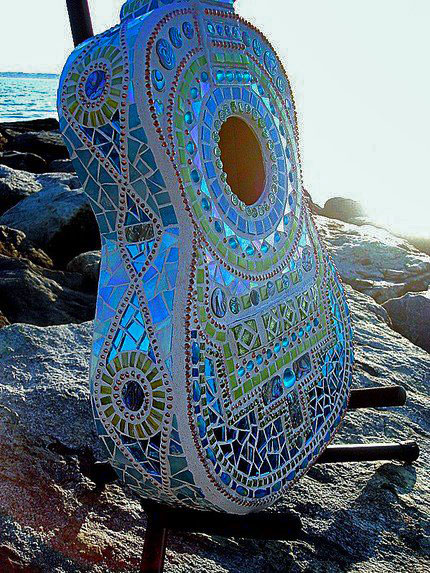
Mosaic Guitar by Mosaic Artist Lisa Calabro   
An artist who takes a very different approach to turning musical instruments into art is American artist Lisa Calabro of Crooked Moon Studio in Warwick, Rhode Island. Lisa has transformed old instruments into artworks by mosaicing them. See more of her lovely mosaics on her website http://crookedmoonstudio.com
Mosaic Violin by Mosaic Artist Lisa Calabro 
Mosaic Guitar by Mosaic Artist Lisa Calabro
Thanks to both Noel and Lisa for allowing me to share their artwork. Thanks also to Bérénice for the use of her photographs of the Philadelphia Flower Show. 

Monday, July 4, 2011

The Bottle Houses, Prince Edward Island

Best Blogger Tips
The use of glass in the landscape is something that has interested me for some time, and is something I hope to incorporate into one of my stone projects at some stage. It is buildings like these bottle houses below that make me want to try it out for myself. What an amazing place it is. And as with all inspiring places lies a compelling story of a innovative mind with a creative dream.
 

The Bottle Houses are located at Cap-Egmont, Prince Edward Island, on the gorgeous east coast of Canada. They were built by the late Édouard T. Arsenault.
In 1979 Édouard received a postcard from his daughter of a glass bottle castle she had visited on Vancouver Island in British Columbia, he was so captivated by it, that he was instantly inspired to make his own glass bottle creation. 
Édouard T. Arsenault
That same summer, he started collecting bottles from his community, from a local restaurant, community dance halls, friends, relatives and neighbours. He spent the winter in the basement of his home, cleaning bottles, removing labels and dreaming of his project. In the spring of 1980, at the age of 66, he began construction of his pet project, not quite sure where it was going to take him. As his six-gabled structure was taking form, visitors started coming in. Impressed by his work, they encouraged him to continue and to advertise it as a tourist attraction. And so, in 1981, the first Bottle House was open to the public.

From 1980 to the spring of 1984, he cleverly cemented over 25,000 bottles of various shapes, sizes and colours, into three fantasy-like buildings.
 
Six Gabled House
The first bottle house was built in 1980 out of approximately 12,000 bottles, measuring 20 feet x 14 feet with three main sections. Its six gables and the patterns produced by the careful choosing of colours and sizes of bottles truly makes this a unique building. Mr. Arsenault would cement between 300 and 400 bottles per row, using a total of approximately 85 bags of cement over a six month period.
The Round Tavern
In 1982, Édouard decided to try his luck at a second building, using approximately 8,000 bottles this time. This tavern-like hexagonal structure was originally used to house the attraction's souvenirs and handcrafted items made by his wife Rosina. Today the tavern houses a large selection of interesting bottles collected by Edouard. Whenever he came across a bottle that had a special feature, he preferred to keep it for display rather than using it in the construction. 
The Chapel
The third building constructed by the late Édouard Arsenault is truly a work of art. Approximately 10,000 bottles were transformed in 1983 to become a magnificent little chapel, complete with pews and altar. At the time of his sudden death at the age of 70, in the spring of 1984, Mr. Arsenault still had a bit of work to do, he intended to make the steeples higher and the front pew was not quite completed. At sunset, a symphony of light and colours streams in from behind the altar.


Rebuilding Works
Unfortunately, Prince Edward Island’s winters are not very gentle. The railway ties used as foundations did not withstand the effects of the bad winter frosts. Over the years, the buildings deteriorated to the point that they had to be rebuilt.
Between 1992 to 1998, the original buildings were photographed from all angles, carefully measured and then brought down by hand, recovering the glass bottles from the mortar. Four foot foundations were then laid before local bricklayers carefully reconstructed the buildings, using the same bottles as in the original structures and following the same basic designs. The roof and the central cylinder of the second building are the only components that were maintained in their original form.

Altogether over 25 000 recycled bottles were ingeniously cemented together to create the Bottle Houses. The houses are nestled in a number of mature gardens originally created by Édouard. He built the stonework and developed the flower gardens surrounding the buildings at the beginning of his retirement years in 1974.
Étienne Gallant at work
on the large bottle
The stones were picked locally by him and put together to create a peaceful setting for the gardens surrounding the houses that were to be built later. A keen gardener, he also planted all the trees on the property and enjoyed growing a wide variety of perennials and annuals. The present owner, his daughter Réjeanne, also enjoys this task from year to year, with the help of her son Étienne Gallant who also designed and built a large bottle near the road. This new thirteen feet high structure required 2,000 bottles.


-------------------------------------------------------------------------------
I still have much to discuss on the topic of recycled glass in the garden, but this is a post for another day. If you would like to see more bottle houses check out this link http://www.agilitynut.com/h/otherbh.html lots more wacky bottle creations to be found there.  The photos for this post are from the bottle house website (used with their kind permission of course) Be sure to check out their website for more information and photos. http://www.bottlehouses.com/