Showing posts with label Drumkeelan. Show all posts

Sunday, December 13, 2015

The Timekeeper

Best Blogger Tips
Earlier in the year I was commissioned under the Per Cent for Art scheme to create a sculpture for a secondary school in Drogheda Co. Louth. 
The brief was to create a piece to commemorate the transition of the school from its humble beginnings into the new extensive extension, the sculpture is based on the subject of the movement of  time. 

Our history traced through stone.

The permanence of stone means that much of what we know about our past has been discovered through examining the stone structures left behind by our ancestors, from structures and sites of worship to the dry stone walls that map out the history of the vernacular landscape of our countryside.  In the Drogheda area alone, more than 5000 years of history can be read through the many stone structures  that cover the landscape here, spanning from the Neolithic site of  Newgrange to the Norman beginnings of the town itself.  This Norman heritage is evident  in the earliest monument in the town which is the motte-and-bailey castle, now known as Millmount Fort.
Karl sits in the timekeeper's seat
'The Timekeeper'  sculpture pays tribute to this movement of time, recorded through stone.
From a distance the large vertical blocks of sandstone  take  on the appearance of a Neolithic structure. As you approach, the sundial element of the sculpture becomes apparent.
The large angled stone in the centre (gnomon) is angled parallel to the earth's axis, paying tribute to the first gnomon style sundials invented in the late 1300's. The bars of engineered limestone in the floor along with the relief carvings of cogs and wheels in the standing stones represent modern time.  
The precision of the limestone markers highlights the slight fluctuation in the accuracy of the shadows cast by the Neolithic gnomon as the seasons change. This in turn highlights the contrast between the rudimentary time mapping of the neoliths with the sophisticated precision of modern engineered time.

The stone seating area in the courtyard between the old and new buildings is an extension of the sculpture, with the time capsule placed  under the stone mosaic in the floor, a symbol of the school's confidence in its future.
The time capsule being placed under one of Sunny's mosaics 
The stone for this project is sandstone and comes from Drimkeelan quarry in County Donegal.  Drimkeelan quarry is one of the oldest working quarries in the country. The Abbey of Assaroe was built in 1180 using this stone, so it is known that quarrying started around this time. A carved sandstone lamp found in the mines of the quarry suggests mining could have already started in the middle ages, by Cistercian monks who had abbeys to build.
Shopping for gnomons with quarry owner Brian Kerrigan at Drimkeelan quarry 
Inside the sandstone mines of Drimkeelan during the Tír Ċonaill Stone Festival  in 2013. Read more about this here
The quarry also supplied stone for famous buildings such as The National Museum of Ireland, Leinster house(The Dail) and Stormont in Northern Ireland .
The piece of white quartzite built into the base of the gnomon links back to the white quartzite facade of the nearby prehistoric site of Newgrange.  
How Sundials Work.


Sundials indicate the time by casting a shadow or throwing light onto a surface known as a dial face or dial plate.
The time is indicated where a shadow falls on the dial face, which is usually inscribed with hour lines.
The entire object that casts a shadow or light onto the dial face is known as the sundial's gnomon.
The gnomon is set parallel to the earth's axis. This angle is horizontal at the equator and increases to vertical (90⁰) at the poles. The angle of the earth's axis is dependent on your location and can be found by checking the latitude on your GPS coordinates. The latitude of Drogheda is 53.717856⁰.
As well as being parallel to the earth's axis, the gnomon also points to the pole (in this case the North Pole.) North, South, East and West are marked on the sculpture on the back of the standing stones and behind the seat stone.
The Sun is highest in the sky at midday and casts a short shadow. In the afternoon, when the Sun is lower in the sky, the shadow is longer.
The length of the shadow is also affected by the seasons. Winter shadows are longer than Summer shadows. This is because the Sun is lower in the sky in Winter.
The speed of the shadow depends on the length of the gnomon. This gnomon, being almost 2 metres tall, means that the tip of the shadow will move about a third of its height (60cm) in an hour - 1cm per minute. This movement is due to the Earth's rotation.

Building the sculpture
Like may stonemason's I usually work alone, however with large projects like this I am lucky to have a great group of friends from the DSWAI who I can call on.
Scaled model 
Ken Curran splitting stone for the gnomon using plugs and feathers 
Sunny places the gnomon 
Ken begins work in the first relief carving
Ken and Sunny work on the carvings
One of Sunny's carvings nearing completion
One of standing stones carved by Ken
Alex Panteleyenko works on cutting the letters for the time capsule seating area as well as the numbers for the sundial
Time capsule seating area under construction 
The dry laid pitched stonework was a very slow process with about 60m2 to be laid in total. Fortunately I had Karl Kennedy and Mark Gregan with me for this stage of the build.
The majority of the stonework was laid in a radial orientation from the gnomon apart from one segment that connects the timekeeper's seat to the gnomon. 
Karl and Nick work in the shadow of the gnomon
Scottish master craftsman Nick Aitken also stopped by for a few days to pitch in while over visiting for one of our trips to work on The Gathering of Stones monument which a number of us are involved in.  
As is often the case when building something unique, this project ended up taking longer than expected, so the pressure was on to get it completed on time. It was a little surreal at times to be building a giant clock when you're under pressure to finish a job.  
Thanks again to the great group of guys who helped me realise this project. It is great to see the praise it is getting, and the process of its construction will hopefully give some of the students in the school an appreciation for the craft and for the work involved in applying those skills.   

Wednesday, June 25, 2014

The birth of a new Stone Festival in Donegal

Best Blogger Tips
Last Thursday I packed my bags and pointed my car north for Donegal. I have been wanting to get to Donegal for some time but for some reason Donegal always seems so far away. But now I had a good excuse to free up some time (as if you need a good reason to go to Donegal)  
Mountcharles Sandstone Pier, Mountcharles, Co. Donegal
Turns out the trip up is not so bad at all, I even had time to stop off along the way at Loughcrew in County Meath to find the ancient stone seat known as The Hag's Chair a massive engraved kerbstone on the north side of Cairn T, at Loughcrew. I have mentioned this seat in a blog post before which you can read here
The Hag's Chair, Loughcrew, Co. Meath
After a good stretch of the legs and a crawl into the centre of Cairn T (a similar structure to Newgrange)  I got back in the car to finish my journey to Donegal. There were many other stone sites along my route which I wanted to visit, but I knew that this was going to be the first of what will become an annual pilgrimage to Donegal, and there would be plenty of opportunities to see these great sites down the line.
"So how's about getting to the point and tell us why you're going to Donegal" you are surely saying by now. 
Well as the title of the post suggests, my trip to Donegal was to be part of an exciting new stone festival that is to be an annual event in Donegal.
Organised by the Donegal branch of The Dry Stone Wall Association of Ireland  (DSWAI) with the support of the Donegal County Council and the ETB  the festival included dry stone wall building, stone letter cutting and carving, talks by master masons and sculptors and topped off with a tour of the local sandstone mine.

Dry Stone Walling 
The dry stone project was set in a picturesque setting along the Donegal coastline on the Wild Atlantic Way by the historic sandstone pier of Mountcharles. This area's rich stone heritage is ever evident, from the walls that line the coastline to the huge local sandstone blocks that form the beautiful Mountcharles Pier, from where the stone from the local quarries was shipped off to build many grand halls and churches around the country and abroad.
Mountcharles Pier
The task for the dry stone walling project was to rebuild a large section of wall that was washed away during a massive storm which left stones scattered over a large area of land it had once protected.

The footprint of the original wall
A pep talk by Rónán Crehan gets the building under way
Scottish Master Craftsman Nick Aitken keeping an eye over the footings  
A dry stone waller in the making
Stonemason Michael Mc Groarty splits and shapes stone to create gate posts
Stones plunged and feathered 
Placing the gate posts
Master Craftsman Sean Adcock from the North Wales branch of DSWA UK keeps local man Donagh O Callaghan and Canadian Jacob Murray on their toes  
The wall builders of day one

Nick Aitken and DSWAI treasurer Louise Price set copping stones 
An old Irish penny from 1941 found in the wall
There is an age old tradition of putting a time capsule in a wall as you build. This is often in the form of a bottle or a coin. I found this old penny from 1941 in between the stones of the original wall footings. I too regularly throw a few coins into a wall (the amount depending on how plush I am feeling at the time) I made sure to throw a few euros into this wall as well for some other mason to find down the line in another 100 years or so.
Rónán Crehan posing in 'stile'
Built using stone from the original wall and recycled stone from a old cottage, all of the stone used is the local sandstone. Over the course of two days over 45 yards of wall was built by a team of about 40 participants per day.  
The finished wall

Stone Carving and Letter cutting Workshop with Brendan McGloin
Located just 500 meters from Mountcharles pier is the lovely Salthill Gardens, the courtyard of which was the location of our stone carving workshops. As you walk towards the gardens from the pier, the soft tapping sounds of hammer on chisel can be heard coming over the high stone walls of the gardens that protect the lush and delicate garden inside from the harsh salty sea air.
Carving at Salthill Gardens
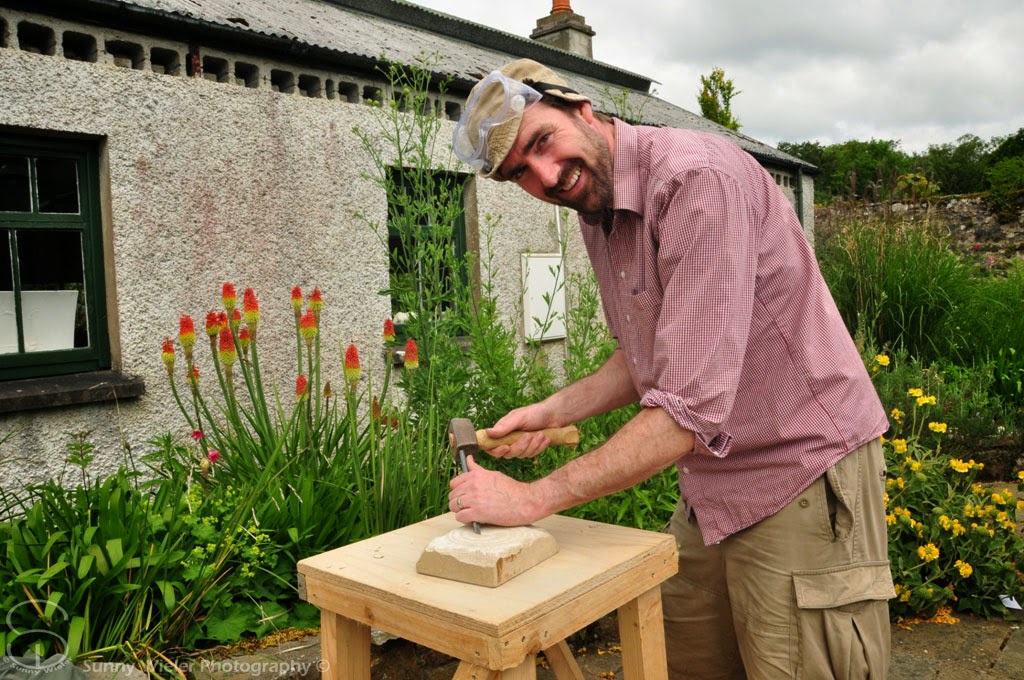
Up to 12 students per day got to try their hand at letter cutting and stone carving

 Kieran Keeney sharpening chisels
Landscape architect Dave Ryan feels at home, surrounded by plants and stone as he carves


The carving workshops were run by sculptor Brendan Mc Gloin who has been working with stone for over 25 years. His legacy to date includes an incredible full scale replica of the high cross of the scriptures at Clonmacnoise. The cross took almost three years to complete and is an incredible site to behold. The finished cross now sits on the summit of Mt Calvary, Portland Oregon, USA. Brendan also gave a fascinating talk and media presentation over the weekend that gave a wonderful insight into the enormity of the project. Click here to see a short 6min film about this work.    
Brendan and his recreation of the cross (Image copyright of Brendan Mc Gloin)
Nick and Louise look in wonder at Brendan McGloin's model of the Clonmacnoise High Cross of which Brendan carved a stunning full scale replica over a 3 year period. 
One of Brendan's carvings on display at Salthill Gardens


A trip to the mines
One of the highlights of the festival was a tour of the sandstone mines of Drumkeelan just a mile northwest of Mountcharles. 

The entrance to the mine
Rónán giving a description on the surface quarry.
Arriving at the quarry entrance
We are met at the entrance of the mine by local historian Eamonn Monaghan, who also gave a fascinating talk at the festival the day before about the history of the stone industry in the area.
Around 300 million years ago in the Carboniferous period Donegal Bay was much larger than in the present day.  It stretched from Killybegs in the west, through Lough Eske in the centre, to Laghy in the east. The Carboniferous rivers were eroding the same hills as we see today (although these would have been much higher and less rounded) carrying sediment into the bay to form the sandstones which occur around Drumkeelan and upon which the stonemasonry industry in the area is based.
In the townland of Drumkeelan, northwest of Mountcharles, is a rock outcrop known as Drumkeelan mine. This site has a very long history of stone mining, back to at least the late 12th century. It provided high quality stone suitable for monumental work and masonry. Some important public buildings, such as the National Museum of Ireland, the National Library, Leinster House (the Dail) and Sligo Town Hall used Drumkeelan stone in their construction. The mine was active up till the 1950's

The effort put into the tour was outstanding. The entire mine shaft was lit up using candles and lamps, just like it would have been during the times it was in use.

One of the original miners oil lamps
Peter, Deirdre and family explore the mines
Sandstone is much softer when it is first taken out of the ground, as it is exposed to the elements the silts wash out of it and it becomes much harder to work. For this reason it was more economical to mine the stone rather than opencast it.
In the mine a weak layer of silt material above the sandstone was removed first making a small space, allowing blocks of stone to be wedged up from their beds and removed. They would then be moved through the mines shaft with the aid of rollers and bars.  As the stone was extracted,  the roof would be supported mainly by a pack of waste stone stacked to the sides like dense dry stone walls. The Abbey Assaroe was built in 1180, so it is known that quarrying started around this time. A carved sandstone lamp found in the mine suggests mining could have already started in the middle ages. Locally the stone was used to build the Killybegs Coastguard Station, the Provincial Bank in Ballyshannon, the Town Hall in Sligo and St Eunan and St Columba Cathedral in Letterkenny
Arriving at a larger chamber, Eamonn stops to sing us a song he wrote about the mine to commemorate the miners who worked there. Click on the video below to hear his song.
For those of you who want to sing along here are the words.

'The Ballad of the Drumkeelan Mines' by local historian Eamonn Monaghan which commemorates the miners:

Deep underneath Drumkeelan, there in the freestone mines each day,
With miners' lamps to light us, we work the hours away,
We punch the holes along the line, in each we place a wedge,
And when they're right & ready, we give each one the sledge,
CHORUS
So swing the hammers high and swing the hammers low,
We must get these blocks out, today before we go,
The stone cutters are all waiting, for these are busy times,
In the Valley of Drumkeelan, where we're working in the Mines.

The stone it is above us, the stone is all around,
Our block is on the rollers, our crowbars on the ground,
We lever it so slowly, along the smooth mine floor,
And when we have it outside, sure we must go back for more,

There's a big Cathedral rising in Letterkenny Town,
They need stone for schools & halls, from here to Co. Down,
For Halls in Derry City and Sligo banks as well,
Sure, we cannot mine it fast enough, the truth to you I'll tell,

Mulreany comes from Drumnalost, here to his work each day,
The Brogans & the Harkins from Drumconnor make their way,
The Hegartys & Harveys & the Bogles come along,
With Wards from Drumagearah they make a jolly throng,

They walk it every morning, from miles & miles around,
To share their skills & ancient crafts and toil beneath the ground,
Like the monks of good St Bernard in far off distant times,
Who worked & prayed for God & Man within these very Mines,

Hearing this song sung deep in the mines was quite special. Encouraged by our applause, Eamonn went on to recite a poem he also wrote about the mines (see video below) 
When researching the mines, Eamonn wanted to get a real sense what it would have been like in there for the workers. He once spent a full week in the mines sleeping on the mine floor absorbing the complete stillness within the shafts. 
The great thing about this mine is that unlike limestone caves and mines, it is not exposed to the same kind of erosion. There are no stalactites to obscure the views. These sandstone mines are completely sterile and are exactly the same as they were in the 1950’s. Down here, I am reminded of my trip to the salt mines in Poland (read about that trip here)
Returning to the surface, evidence can be seen of how modern quarrying is destroying the mines. In the picture below, old mine shafts are hidden behind the heaps of rubble. The rock that would have been the mine roof is broken down into smaller building stone mainly used for building walls and cladding houses. (a 20 ton truck load of this stone was also donated to The Gathering of Stones project as you might remember) 
Today there is only two of the mine shafts remaining. There is talk of preserving the last two so that the history of these mines will live on and that more people will be able to come and experience these wonderful tours. Let us hope the powers that be step up and help preserve this unique piece of our heritage before it is too late. One ponders on what a wonderful unique tourist attraction this could make!    
Rónán and Jacob modelling the festival Tshirts. You can order your festival Tshirt through the DSWAI website here  

And so with the end of the tour, so too came an end to our festival. And with one last step through the 'stile' I said my farewells to Donegal and its fine people, hoping to return again soon. Now in the knowledge that I am only a comfortable 3 hour drive away I am sure I will be back a lot sooner than the next Tirconnell Stone Festival. 

From left DSWAI Chairman Sunny Wieler, festival organiser Louise Price, Canadian Jacob Murray and festival organiser Rónán Crehan  

Finnaly I would like to say a big thanks to everyone involved in making this event happen. From the quarry men to the admin people, to the tea lady and stone gatherers and of course the different organisations and local councillors who helped make it happen. 
Here in Donegal I felt a great sense of pride of county and of its stone heritage that I have not experienced to the same level in other counties. This festival is a credit to the craft and the people of Donegal. Let the dry stone revolution continue.....