Showing posts with label DSWAI event. Show all posts

Wednesday, June 25, 2014

The birth of a new Stone Festival in Donegal

Best Blogger Tips
Last Thursday I packed my bags and pointed my car north for Donegal. I have been wanting to get to Donegal for some time but for some reason Donegal always seems so far away. But now I had a good excuse to free up some time (as if you need a good reason to go to Donegal)  
Mountcharles Sandstone Pier, Mountcharles, Co. Donegal
Turns out the trip up is not so bad at all, I even had time to stop off along the way at Loughcrew in County Meath to find the ancient stone seat known as The Hag's Chair a massive engraved kerbstone on the north side of Cairn T, at Loughcrew. I have mentioned this seat in a blog post before which you can read here. 
The Hag's Chair, Loughcrew, Co. Meath
After a good stretch of the legs and a crawl into the centre of Cairn T (a similar structure to Newgrange)  I got back in the car to finish my journey to Donegal. There were many other stone sites along my route which I wanted to visit, but I knew that this was going to be the first of what will become an annual pilgrimage to Donegal, and there would be plenty of opportunities to see these great sites down the line.
"So how's about getting to the point and tell us why you're going to Donegal" you are surely saying by now. 
Well as the title of the post suggests, my trip to Donegal was to be part of an exciting new stone festival that is to be an annual event in Donegal.
Organised by the Donegal branch of The Dry Stone Wall Association of Ireland  (DSWAI) with the support of the Donegal County Council and the ETB  the festival included dry stone wall building, stone letter cutting and carving, talks by master masons and sculptors and topped off with a tour of the local sandstone mine.

Dry Stone Walling 
The dry stone project was set in a picturesque setting along the Donegal coastline on the Wild Atlantic Way by the historic sandstone pier of Mountcharles. This area's rich stone heritage is ever evident, from the walls that line the coastline to the huge local sandstone blocks that form the beautiful Mountcharles Pier, from where the stone from the local quarries was shipped off to build many grand halls and churches around the country and abroad.
Mountcharles Pier
The task for the dry stone walling project was to rebuild a large section of wall that was washed away during a massive storm which left stones scattered over a large area of land it had once protected.

The footprint of the original wall
A pep talk by Rónán Crehan gets the building under way
Scottish Master Craftsman Nick Aitken keeping an eye over the footings  
A dry stone waller in the making
Stonemason Michael Mc Groarty splits and shapes stone to create gate posts
Stones plunged and feathered 
Placing the gate posts
Master Craftsman Sean Adcock from the North Wales branch of DSWA UK keeps local man Donagh O Callaghan and Canadian Jacob Murray on their toes  
The wall builders of day one

Nick Aitken and DSWAI treasurer Louise Price set copping stones 
An old Irish penny from 1941 found in the wall
There is an age old tradition of putting a time capsule in a wall as you build. This is often in the form of a bottle or a coin. I found this old penny from 1941 in between the stones of the original wall footings. I too regularly throw a few coins into a wall (the amount depending on how plush I am feeling at the time) I made sure to throw a few euros into this wall as well for some other mason to find down the line in another 100 years or so.
Rónán Crehan posing in 'stile'
Built using stone from the original wall and recycled stone from a old cottage, all of the stone used is the local sandstone. Over the course of two days over 45 yards of wall was built by a team of about 40 participants per day.  
The finished wall

Stone Carving and Letter cutting Workshop with Brendan McGloin
Located just 500 meters from Mountcharles pier is the lovely Salthill Gardens, the courtyard of which was the location of our stone carving workshops. As you walk towards the gardens from the pier, the soft tapping sounds of hammer on chisel can be heard coming over the high stone walls of the gardens that protect the lush and delicate garden inside from the harsh salty sea air.
Carving at Salthill Gardens
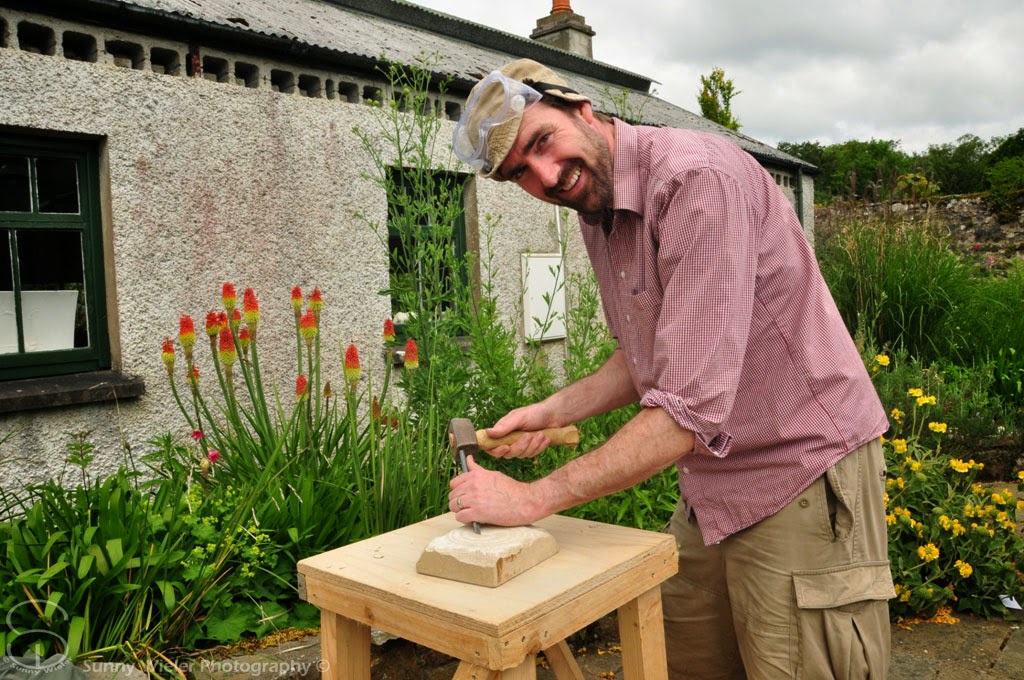
Up to 12 students per day got to try their hand at letter cutting and stone carving

 Kieran Keeney sharpening chisels
Landscape architect Dave Ryan feels at home, surrounded by plants and stone as he carves


The carving workshops were run by sculptor Brendan Mc Gloin who has been working with stone for over 25 years. His legacy to date includes an incredible full scale replica of the high cross of the scriptures at Clonmacnoise. The cross took almost three years to complete and is an incredible site to behold. The finished cross now sits on the summit of Mt Calvary, Portland Oregon, USA. Brendan also gave a fascinating talk and media presentation over the weekend that gave a wonderful insight into the enormity of the project. Click here to see a short 6min film about this work.    
Brendan and his recreation of the cross (Image copyright of Brendan Mc Gloin)
Nick and Louise look in wonder at Brendan McGloin's model of the Clonmacnoise High Cross of which Brendan carved a stunning full scale replica over a 3 year period. 
One of Brendan's carvings on display at Salthill Gardens


A trip to the mines
One of the highlights of the festival was a tour of the sandstone mines of Drumkeelan just a mile northwest of Mountcharles. 

The entrance to the mine
Rónán giving a description on the surface quarry.
Arriving at the quarry entrance
We are met at the entrance of the mine by local historian Eamonn Monaghan, who also gave a fascinating talk at the festival the day before about the history of the stone industry in the area.
Around 300 million years ago in the Carboniferous period Donegal Bay was much larger than in the present day.  It stretched from Killybegs in the west, through Lough Eske in the centre, to Laghy in the east. The Carboniferous rivers were eroding the same hills as we see today (although these would have been much higher and less rounded) carrying sediment into the bay to form the sandstones which occur around Drumkeelan and upon which the stonemasonry industry in the area is based.
In the townland of Drumkeelan, northwest of Mountcharles, is a rock outcrop known as Drumkeelan mine. This site has a very long history of stone mining, back to at least the late 12th century. It provided high quality stone suitable for monumental work and masonry. Some important public buildings, such as the National Museum of Ireland, the National Library, Leinster House (the Dail) and Sligo Town Hall used Drumkeelan stone in their construction. The mine was active up till the 1950's

The effort put into the tour was outstanding. The entire mine shaft was lit up using candles and lamps, just like it would have been during the times it was in use.

One of the original miners oil lamps
Peter, Deirdre and family explore the mines
Sandstone is much softer when it is first taken out of the ground, as it is exposed to the elements the silts wash out of it and it becomes much harder to work. For this reason it was more economical to mine the stone rather than opencast it.
In the mine a weak layer of silt material above the sandstone was removed first making a small space, allowing blocks of stone to be wedged up from their beds and removed. They would then be moved through the mines shaft with the aid of rollers and bars.  As the stone was extracted,  the roof would be supported mainly by a pack of waste stone stacked to the sides like dense dry stone walls. The Abbey Assaroe was built in 1180, so it is known that quarrying started around this time. A carved sandstone lamp found in the mine suggests mining could have already started in the middle ages. Locally the stone was used to build the Killybegs Coastguard Station, the Provincial Bank in Ballyshannon, the Town Hall in Sligo and St Eunan and St Columba Cathedral in Letterkenny
Arriving at a larger chamber, Eamonn stops to sing us a song he wrote about the mine to commemorate the miners who worked there. Click on the video below to hear his song.
For those of you who want to sing along here are the words.

'The Ballad of the Drumkeelan Mines' by local historian Eamonn Monaghan which commemorates the miners:

Deep underneath Drumkeelan, there in the freestone mines each day,
With miners' lamps to light us, we work the hours away,
We punch the holes along the line, in each we place a wedge,
And when they're right & ready, we give each one the sledge,
CHORUS
So swing the hammers high and swing the hammers low,
We must get these blocks out, today before we go,
The stone cutters are all waiting, for these are busy times,
In the Valley of Drumkeelan, where we're working in the Mines.

The stone it is above us, the stone is all around,
Our block is on the rollers, our crowbars on the ground,
We lever it so slowly, along the smooth mine floor,
And when we have it outside, sure we must go back for more,

There's a big Cathedral rising in Letterkenny Town,
They need stone for schools & halls, from here to Co. Down,
For Halls in Derry City and Sligo banks as well,
Sure, we cannot mine it fast enough, the truth to you I'll tell,

Mulreany comes from Drumnalost, here to his work each day,
The Brogans & the Harkins from Drumconnor make their way,
The Hegartys & Harveys & the Bogles come along,
With Wards from Drumagearah they make a jolly throng,

They walk it every morning, from miles & miles around,
To share their skills & ancient crafts and toil beneath the ground,
Like the monks of good St Bernard in far off distant times,
Who worked & prayed for God & Man within these very Mines,

Hearing this song sung deep in the mines was quite special. Encouraged by our applause, Eamonn went on to recite a poem he also wrote about the mines (see video below) 
When researching the mines, Eamonn wanted to get a real sense what it would have been like in there for the workers. He once spent a full week in the mines sleeping on the mine floor absorbing the complete stillness within the shafts. 
The great thing about this mine is that unlike limestone caves and mines, it is not exposed to the same kind of erosion. There are no stalactites to obscure the views. These sandstone mines are completely sterile and are exactly the same as they were in the 1950’s. Down here, I am reminded of my trip to the salt mines in Poland (read about that trip here)
Returning to the surface, evidence can be seen of how modern quarrying is destroying the mines. In the picture below, old mine shafts are hidden behind the heaps of rubble. The rock that would have been the mine roof is broken down into smaller building stone mainly used for building walls and cladding houses. (a 20 ton truck load of this stone was also donated to The Gathering of Stones project as you might remember) 
Today there is only two of the mine shafts remaining. There is talk of preserving the last two so that the history of these mines will live on and that more people will be able to come and experience these wonderful tours. Let us hope the powers that be step up and help preserve this unique piece of our heritage before it is too late. One ponders on what a wonderful unique tourist attraction this could make!    
Rónán and Jacob modelling the festival Tshirts. You can order your festival Tshirt through the DSWAI website here  

And so with the end of the tour, so too came an end to our festival. And with one last step through the 'stile' I said my farewells to Donegal and its fine people, hoping to return again soon. Now in the knowledge that I am only a comfortable 3 hour drive away I am sure I will be back a lot sooner than the next Tirconnell Stone Festival. 

From left DSWAI Chairman Sunny Wieler, festival organiser Louise Price, Canadian Jacob Murray and festival organiser Rónán Crehan  

Finnaly I would like to say a big thanks to everyone involved in making this event happen. From the quarry men to the admin people, to the tea lady and stone gatherers and of course the different organisations and local councillors who helped make it happen. 
Here in Donegal I felt a great sense of pride of county and of its stone heritage that I have not experienced to the same level in other counties. This festival is a credit to the craft and the people of Donegal. Let the dry stone revolution continue.....  

Sunday, July 14, 2013

The Gathering of Stones in the heart of Ireland

Best Blogger Tips
After months of anticipation, stones, masons and dry-stone enthusiasts from the four corners of Ireland as well as the rest of the world came to a head in the center of Ireland.  
June 20th 2013 marked the beginning of The Gathering of Stones.
Stories were shared, songs were sung (and written) and monuments were built.
  
Just like the cross marked the spot in the posters, the 'Emigrant Stones' mark the centre of our dry stone monument.

From the beginning.

Last summer after Feile na gCloch on Inis Oírr, Tomas Lipps, director of The Stone Foundation stayed with me while doing fieldwork for his publication Stonexus magazine. Over a few pints of the black stuff one night we discussed the possibility of the DSWAI and The Stone Foundation collaborating on a event in Ireland. At almost exactly the same time Nick Aitken of the DSWA in Scotland contacted the us suggesting that this being the year of The Gathering Ireland, we should build a monument in the center of Ireland to commemorate this in a way that also celebrates the craft we all love so much.
It was these early conversations that sowed the seeds for what would become 'The Gathering of Stones 2013'
The concept for our monument.
Our primary idea was to create a gathering point for people to congregate, a circle seemed the most appropriate shape to begin with.  
The bi-vallate  (twin walled) enclosure also reflects Ireland's built heritage.  The ringfort is the most common archaeological site to be seen in the Irish landscape. The status of a ring fort is not only evident by its diameter but more significantly through the number of rings it contains.  Therefore, a bi-vallate enclosure would often be the seat of the local lord or the central focal place for a network of ring forts which formed a community.
The outer wall symbolises the 4 provinces.  Thus the Island of Ireland and all its people, with its many varying ways and vernacular styles, forms a comforting embrace around the 5th province. That fifth province once had a physical existence here in the Iron Age and was known as Breifne.  However, the King of Breifne (Michael McMurtaigh) was driven from Ireland after attempting to unite the country under a single monarch.  In addition, in this structure the fifth province also represents the individual, creativity, imagination and the Diaspora.
The structure represents the country of Ireland and a welcome home to the people who left and never returned.  The outer walls embrace the creative mind, the millions of souls and talents who left our shores and spread their skills far and wide. 
It becomes entirely appropriate that the 'Emigrant Stones should be laid in cruciform shape at the centre of the sculpture embracing people from all corners of the world       


A crest for each province.

The monument includes the crest of the four provinces (60x 60cm). Four DSWAI members who are also stone carvers donated these carvings to the monument. 
Alex Panteleyenko working on the Ulster crest, with a bit of help from Christian Helling

Victor Daly's carving of the three crowns of Munster was carved in Valletta Slate. Alex's red hand of Ulster was carved in Donegal Sandstone. Julia's Harp of Leinster is carved in Tipperary blue limestone and the Connacht Crest of arms was carved by Christian in Liscannor sandstone.   
The four finished crests. (from left, Victor Daly (Munster), Alex Panteleyenko (Ulster), Julia Gebel (Leinster), Christian Helling (Connacht) 
To build a dry stone monument, you need a hell of a lot of stone!

The completed structure will consume an estimated 300 tonnes of stone. As you can imagine, the logistics of getting 300 tonnes of stone from the four corners of Ireland and beyond to our central location is no mean feat. Trying to do this without any funding seemed like an impossible task. After the crushing news that the review board for 'The Gathering' in County Offaly refused to pass our application to be funded as a 'Flagship event', the outlook for our event looked very bleak. However the DSWAI decided to take a leap of faith and call on the people of Ireland to help us make this event happen.

A call for stone was made, and the proud farmers and quarrymen of Ireland answered.

Thomas Egan, Rodger Degan, Mick Connelly and Padraig Larkin  (missing from  photo Don O’Boyle) collecting local Boora limestone donated to the project by  Joe Molloy. Photo Ken Curran. More about this stone here
Quarryman Brian Kerrigan & haulier Padraig Meehan loading Brian’s donation of a truckload of Drumkeelan stone from Donegal. Photo Louise Price. More about this in Louise's blog post here 
Stones from the four corners of the world.


As part of the event, attendees and the public were invited to bring a stone home to Lough Boora, to become part of the monument. It was wonderful to see how the public took to the project, bringing stones and stories with them. Many people have connections with stones and many of us have taken a stone with us from a place we have made a connection with, be it a pebble from a beach or a stone from a mountaintop. It is these connections with stones that made the whole event emotionally charged and it is only as these stones and stories began to collect on site that the importance of this monument really started to sink in with those building it.
Katherine with her stone from Coolanarney, Blueball, Co.Offaly. "Katherine – who brings a stone from her old home place, now a tumbled memory.  As a child she ploughed and thatched alongside her father, and carried stones to pile atop of walls of ancient fields.  It means everything – her stone" Photo and quote from Louise Price's blog Limewindow
    Stones from New York and Wales

There are also a number of historically significant stones have made long journeys over land and sea to be incorporated into the monument. The most poignant of all is the four 'Emigrant stones' from Battery Park in New York. For millions of emigrants, their first steps in the New World would have been onto these stones after registering at Ellis Island, including nearly everyone from Ireland during the famine years and after.  These stones seemed to really capture the public's imagination, with a constant stream of visitors throughout the four days having their photos taken standing on them.

These stones had a long journey, starting back in the early 1800's when they were quarried in various parts of New England to become part of the emigrant docks at Battery park that date back to the 1700's.
Removal of  the 'Emigrant stones' from Battery park in 2002
The arrival of the 'Emigrant Stones' from New York at Irish Shipping and Transport's depot in Dublin.
Read more about the arrival of the 'Emigrant Stones' here 
Here they lay on the rivers edge until their removal by RJW Campbell during the reconstruction of Battery Park in 2001. When the president of RJW Campbell, Bobby Watt  heard about the event, he immediately offered these stones to the project. Bobby, a Scottish stonemason and Stone Foundation Member based in Canada is also a fine songwriter and singer. In the video below he tells the story of the stones and also signs the poignant "Whispering Stones" a song he composed after being inspired by the event. This song brought a tear to many an eye when first played at "Stories and Stones" and again when reprised by Rónán Crehan at the conclusion of the 4 day event.


Stones from the DSWA UK Wales branch

Sean Adcock setting the Welsh
sleeper stone in the central feature. 
We were also lucky enough to have Sean Adcock join us for the event.  Sean is a DSWAUK master Dry Stone Waller and Secretary of the North Wales Branch of the DSWA. He has prolifically produced books and papers on the craft of dry stone waling and standards in the profession over the years. Sean is the editor of Stonechat magazine amongst many other contributions to the world of dry stone building. He also oversaw the building of the central feature over the course of the event. In the months leading up to the event Sean helped behind the scenes with working out the structural details of the inner structure.

The DSWA also wanted to donate a stone to the project, Sean was also involved in the organisation and transportation of two stones from Wales to Lough Boora.
Originally Sean was working on getting a boulder from the birthplace of Saint Patrick in Banwen (near Neath, South Wales) but when the logistics of this became impossible, he managed to find two other historic Welsh stones with an Irish connection to bring with him. These were a sleeper stone from the Ffestiniog Railway and a stone from the old Breakwater Quarry.

The Ffestiniog Railway stone
Fred Howes, Chairman of Ffestiniog Railway Heritage Group at the Railway's Minffordd Yard alongside the granite sleeper stone donated to the event. Photo Sean Adcock
The Ffestiniog Railway started life as a gravity/horse drawn tramway built in the 1830s, to provide a transport route from the Slate quarries of Blaenau Ffestiniog to the port at Porthmadog, a distance of over 13 miles.The creation of the tramway was made possible largely through Irish investment. The original tramway rails were secured to stone blocks, with around 4000 to a mile.  When the tramway became a narrow gauge steam railway in the 1860s - the world's first narrow gauge railway built to haul over a longer distance than just short shunting.  At this point much of the track-bed was widened and the a new rail/sleeper system introduced.  Many of the stone blocks were incorporated into the new trackside walls.  One of the original granite blocks has been donated to the Gathering of Stones by The Ffestiniog Railway. Read more about these stone in Sean Adcocks article here
The Ffestiniog sleeper stone built into the inner structure of the monument.
 The Breakwater Quarry Stone
View of the breakwater from Holyhead Mountain and extracting the stone to bring to Lough Boora. Photos courtesy of Sean Adcock
Holyhead is the main port in North Wales and provides a direct link with Dublin via the Stena Line and Irish Ferries.  At 1.7 miles in length, Holyhead breakwater is the longest in the UK. Started in 1845, it took 28 years to complete and consumed over 7 million tonnes of stone quarried from nearby Holyhead Mountain.  These quarries now form part of Breakwater Country Park.
 The last blasted rockfall remains alongside one quarry face  and a stone from alongside this has been donated to the gathering of Stones by Breakwater Country Park/Isle of Anglesey County Council with the permission of RSPB and NRW. Read more about these stone in Sean Adcocks article here 

The founding members of the DSWAI Fran Coady, Ken Curran and Waldemar Wower move the Welsh Breakwater stone into place in the center of the Munster wall during the Gathering of Stones. Photo Louise Price
Building the Gathering of Stones
Pinpointing the center of the monument. Canadian Stone Foundation member Tom Parkin with three of the GoS organisers, Nick Aitken, Sunny Wieler and Ken Curran. Photo Fran Coady.    
Not only was there a great mix of sunshine and showers over the weekend, there was also a great mix of professional stonemasons/drystone wallers and amateur stone enthusiasts. The public too became very captivated by the event with a constant stream of spectators arriving over the weekend, many bringing a stone with them to be incorporated into the monument. This vibrant atmosphere around the site quickly warded off any threatening rain clouds, and kept the morale on site high.
Project manager Ken Curran points with resolution as project managers do so well.
Work begins on the Ulster wall
Donegal DSWAI member Rónán Crehan leading works on the Ulster wall

Scottish master craftsman Nick Aitken chats with
Helmut Schieder from Austria,
Tom Parkin of Canada and Irish man Damian Williams

Looking through one of the entrances. Ulster wall on the left, Connaught on the right.
John Lyons of Irish Shipping and Transport standing on one of the 'Emigrant Stones' he helped get across the Atlantic Ocean from New York to Lough Boora.   
Work progressing well on the boulder wall of Leinster in the foreground
A great weekends work. Will post more when we return to finish the structure in the coming weeks.

A wonderful weekend. Thanks to all those who came and gathered stones with us for the weekend.  
A BIG Thank you from the DSWAI
 'The Gathering of Stones' as the first major event of DSWAI was a real success with much being achieved.
One thing which was important to the committee was that the participants enjoyed the experience and went away with a sense of having achieved something. We feel that this goal was achieved and feedback from all the folk who took part has so far been very positive, with quite a few itching to get back to help put the finishing touches to the sculpture.
The Gathering of Stones is a concept far bigger than the collecting of rocks to build a sculpture. It is as much about people as it is about anything else.
Perhaps, even more so?
This was quite evident during the course of the 4 days during which the event took place with the arrival of many people from around the country to place a stone at the site or within the walls.
The imagination of people has been captured by the project.
I believe one of the reasons for this is because 'real' people have been involved in the development of the project from day one.

Thanks to all those who contributed by investing their ideas, time, stone, resources, money and belief in the project. We give you all our assurance that we will bring the project to completion soon.

With the appeal out of the way there are many many people the association wishes to thank from deep in our hearts.

Those people are:
  • The builders;
Padraig Larkin, Christian Helling, Ronan Crehan, Louise Price, Oisin Price, Eddie Farrelly, Nick Aitken, Sean Adcock, Sunny Wieler, Ken Curran, Joanna Williams, Lucy Warmington, Barry & Jacob Noyce, Frank Gleeson, Eamonn Carthy, Thomas Donnelly, Cait Fealty, Caitriona Fealty, Tom Parkin, Michele Carini, Richard Schrade, Victor Daly, Waldemar Wower, Fran Coady, Damian Williams, Karl Kennedy, Sandro Cafolla, Dariusz Jurkiewicz, Seamus May, Mark O’Loughlin, Malachy Sheehan, Helmut Schneider, Alex Panteleyenko, Charlie McFadden, Scott Hyslop, Shaun McFadden, Anne Holland, Simon Hickey, Lynne Hoare, Herbert O’Toole, Liam Friel and Liam Walsh
  • The organising committee of;
Nick Aitken, Tomas Lipps, Sunny Wieler, Eddie Farrelly, Ronan Crehan, Alex Panteleyenko, Ken Curran and Francis Coady

  • For contributing the Emigrant Stones and writing Whispering Stones Bobby Watt (RJW Cambell). You gave the boys a real lift.

  • For making sure the Emigrant Stones got to Montreal from Ottawa Danny Brennan and Pat Kelly.

  • For getting the Emigrant Stones across the Atlantic.
     John Lyons (Irish Shipping and Transport)


To the carvers for producing the four wonderful provincial crests:

To all those who donated stone to the project:
  • DSWAI members would like to thank DSWA Wales Branches members for donating the quartzite boulder from the breakwater quarry at Holyhead and the railway sleeper block from the Festiniog Railway, delivered by hand through Sean Adcock.
  • Mick Kelly (a proud Connacht man from Roscommon living in nearby Kilcormac) for the many tons of Connacht limestone he hand-picked and delivered to us.
  • Rodger Deegan for the hours and hours of work he has (and continues to) put in to the project, plus the huge volumes of stone he donated. We could not have done it without him. 
  • Niall and Michael at McKeon Stone in Stradbally for the beautiful dimension stone which will form part of the arches and building stone in the central feature as well as to be used in seating areas.
  • McMonagles  from Mountcharles in Donegal. For supplying the quartzite used in the Ulster wall.
  • For donating a truck load of Sandstone for the Ulster wall Drimkeelin Sandstone from Donegal.
  • David O'Connor of Liscannor Flagstone for donating building stone and those wonderful slabs of Liscannor to be used as further seating areas.
  • Joe Molloy (local farmer) for donating the fine Boora limestone from his farm.
  • The Sculpture Parklands staff, Thomas Egan, Rodger Deegan, Don O’Boyle, PJ and Mick Connelly. For believing in the concept, for their continuing support and enthusiasm through the grounds staff. For preparing the site so well and providing facilities for people over the weekend. Also, for excavating so many tons of lovely blue limestone used throughout the project.
  • Don O’Boyle for making the profiles and scaffolding and any other steel works we required.
  • Pat Dooley for hunting high and low in search of stone for the project. Many thanks Pat.
  • Tony Maher of Maher Stone Stradbally for donating (and delivering) the bags of lovely green Sandstone.
  • Kilkenny Blue limestone for giving us a small bit of their waste off-cuts.


Local Boora stone being
delivered. Photo Ken Curran
To those who helped with transport:
  • Thank you to Sean Fox for transporting the Emigrant Stones from Irish Shipping's depot in Coolock to Lough Boora.
  • Thanks to Donal from Roscrea Express for moving stone for the association free of charge.
  • Thanks to Pauric and Enda Meehan of Meehan Brothers for hauling all that stone down from Donegal (close to 50 tons!).
  • Rodge Deegan and Mick Connolly of Bord na Mona for hauling all that stone from Cadamstown to the site.
  • To Bord na Mona themselves for moving the Boora stone from Jo Molloy’s farm and from various locations including McKeons in Stradbally as well other places locally to the site.

To those in the media who helped with promoting the event:
  • Karen O’Grady from the Midland Tribune
  • Katriona McFadden, Fergus, Derek, and all on RTE Radio 1’s The Mooney Show.
  • Rebecca Kelly and the Irish Hospice Foundation for inviting us to be a part of their book on gathering events.
  • Jim Finn at Tipp Fm for having us on the show
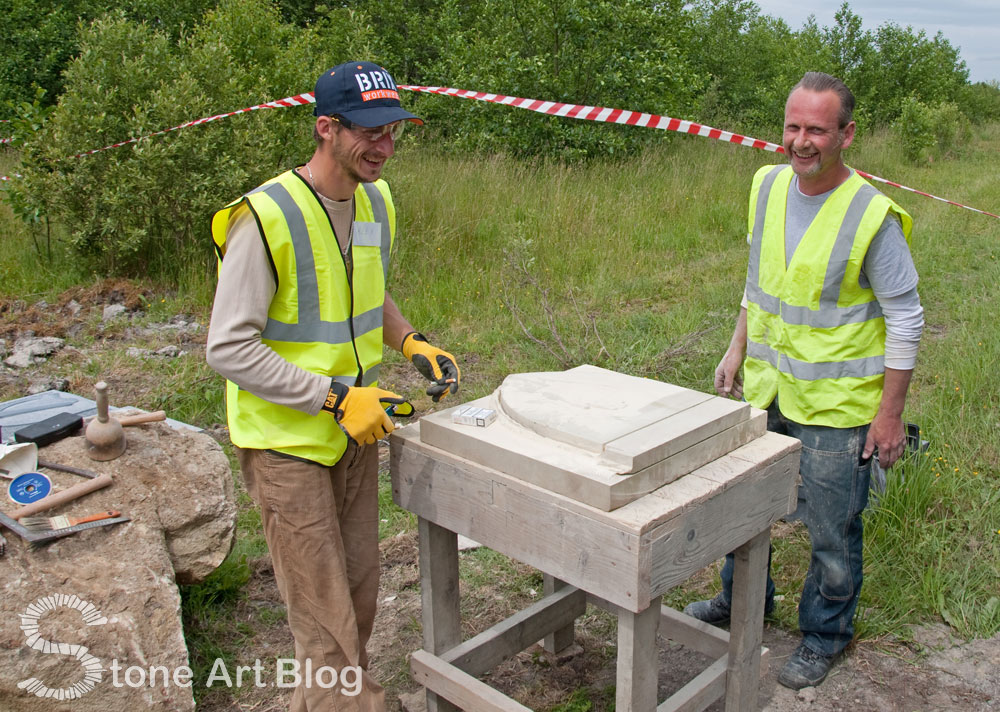
  • Thanks to Paul and all at Brix Workwear for donating our safety gear.
  • Thanks to Banagher Concrete for saving our lives with the heavy gauge re-inforcing bars to make our profiles for the inner valette.
  • To Kitty Curran for all her help with sending out endless press releases, letters and for her continuing help behind the scenes.

  • Many thanks to Tom Parkin, Tori and Christine for running the shop, meeting the public and being the information point for people.

  • Thanks a million for Tori for looking after the catering.

  • Thanks to Barry Bryan for cooking and serving the lunches.
  • A big thanks to Sean Corrigan (Corrigan’s Bar, Ferbane) for bringing us water, drinks, snacks and lots of delph and cutlery for serving the food onto.
  • Thank you to Dooleys' Hotel and The Maltings B&B, both in Birr, for looking after our participants very well and offering them generous discounts on accommodation and food.
  • A big thank you to all those who donate money or came down to the site and offered us words of encouragement or contributed a stone.
  • The organizing committee would like to thank very much their spouses, partners and family members for the support, patience and encouragement during the planning and delivery of the event. We love you all very much
Stones bearing names of loved ones.

It should be noted that it is far from too late to be involved with this project.
Whether it’s:
donating stone for building
helping with transport
getting involved in the building
or even digging into your pocket to make a financial contribution.
We still do not have funding and every little bit (really! anything! even as little as €5) will help to push this forward.
Get involved, be a part of it.
Don’t look back and regret not having contributed something to this ground-breaking moment for Irish dry stone construction.
It is pretty amazing what has been achieved considering that we have had ZERO financial backing for this event. Funding is something that we do desperately need so please consider donating what ever you can. 


We also have a small number of the hugely popular Gathering of Stones Tshirts available for purchase. These limited edition Tshirts cost €20 plus postage and packaging. All proceeds of the Tshirts go to funding the Gathering of Stones event.

Tshirt with Postage and Packing
Size


If you wish to visit the monument, it can be found in the Lough Boora Sculpture Park between Tullamore and Birr in County Offaly. View The Gathering of Stones, Lough Boora Parklands in Google maps (GPS Coordinates +53° 13' 5.59", -7° 43' 34.37"