Showing posts with label Inis Oírr. Show all posts

Tuesday, October 1, 2013

Feile na gCloch (Festival of Stone) 2013 Inis Oírr Island

Best Blogger Tips
So two weekends ago I made my annual retreat to Inis Oirr, the smallest of the three islands that make up the Arran Islands in Galway bay. Although this was only my third year attending Feile na gCloch (Festival of Stone) it feels like I have been coming here for many years. Despite the fact that I was born and raised in west Cork, arriving on the island I get an relaxed feeling of familiarity and a sense of coming home. 
This is the effect this island has on you. It is a world of its own. You won't find any road rage here, no 'zombies' walking into each other as they seem to be unable to lift their heads out of their smart phones, no news flashes of our pending doom. Here modern life dissolves and becomes insignificant. If you want to go somewhere here, you walk. If you pass someone on the road, you look into their eyes and say a friendly hello. And if you want to know the news you go to the pub for a chat.    

My annual visit to Inis Oirr is of course not just to bask in the exuberance of island life. It is also to attend the Feile na gCloch (Festival of Stone). 
The festival is organised and run by the country's most knowledgeable and experienced drystone waller, Patrick McAfee, in conjunction with the wonderful Marie Mannion, Heritage Officer of Galway County Council and Paddy Crowe, manager of the Inis Oirr Cooperative.  

Under the instruction of Pat McAfee and Scottish master craftsman George Gunn, this years participants constructed a 130 feet section of wall in just two days. The style of wall built was a Feidín wall, a wall unique to Ireland and this part of the country in particular.  
A mix of both armature and professional stonemasons working on the wall. 

Scott Hackney co-director of Stonefest in Seattle also returning for another Feile na gCloch   

George Gunn and Donegal DSWAI member Rónán Crehan smile for the camera (well Rónán dose at least)
Capping off the double wall with a large single course

In just two days the 130 foot long Feidín wall is complete 


This year's Feile na gCloch was bigger than ever, with the addition for the first time ever of a stone sculpting and letter carving workshop run by two master carvers from America Alexandra Morosco and Karin Sprague
Alexandra giving Rory a few pointers on a block of native island stone. 

Artist and regular Feile na gCloch goer, Louise Price swaps the paint brushes for  hammers and chisels for the weekend


Karin and Aexandrea also got to leave their own mark on the island by creating this stunning memorial for the islanders to commemorate all those who lost their lives at sea.
Photo courtesy of Karin Sprague
Literally working on top of each other, they managed to transform this local coastal boulder into a moving tribute in just three weeks.

The stone depicts a traditional Irish boat a 'Currach' being engulfed by waves.

The stone now sits just meters from where it lay, on the north west  side of the island.
"Maireann a gcuimhne fos i m' aigne" "We will always remember them in our mind." Photo courtesy of Karin Sprague


The wall built during the festival was already completed on the Saturday, which gave people the opportunity to go on a guided walk with Pat McAfee to explore some of the wonderful wall styles on the Island. In fact it is believed that almost every style of wall can be found here including countless unclassified ones.  


I tend to spend a lot of time walking around the island when I'm here. This year I was taking particular attention to some of the amazing textures and patterns in the walls.

Maybe it was the Guinness from the night before, but stare at some of these walls long enough and they almost seem to move and become fluid. 

Textures in stone

And thus, Feile na gCloch 2013 comes to an end , and with a heavy heart and a heavy back pack (as a result of the new Throw and Holden 'Stone buster' hammer I acquired over the weekend) I leave the island with one final panoramic view form our little seven seater plane back to the mainland. 

Touching down at Connemara Airport after our six minute flight, reality sets back in, and I get back into my motorised vehicle and propel myself back to the city. 

Saturday, October 6, 2012

Feile na gCloch (Festival of Stone) 2012 Inis Oírr Island

Best Blogger Tips
On the fourth weekend of September I once again headed off to Inis Oirr (Inisheer) on the Aran Islands for this year's Feile na gCloch (Festival of Stone). 
The festival is organised and run by the country's most knowledgeable and experienced drystone waller, Patrick McAfee, in conjunction with the wonderful Marie Mannion, Heritage Officer of Galway County Council and Paddy Crowe, manager of the Inis Oirr Cooperative.  
Group photo courtesy of Karl Kennedy 
Every year this event seems to get bigger and bigger, as does the list of international experts and speakers at the event. This year saw John Shaw-Rimmington of Dry Stone Walls Across Canada, Tomas Lipps of the Stone Foundation, Santa Fe, New Mexico, Alexandra Morosco of Stonefest, Seattle, and Scott Hackney of Marenakos Stone, Seattle and co-director of Stonefest share their knowledge as well as giving inspirational presentations on some of the amazing things happening with stone in many different parts of the world.  

There were many other international people in attendance at the stone festival, including people from France, Switzerland, Australia, Netherlands, Ukraine, England ,Finland and the USA. 
Also in attendance was seven of the eight person committee of the Dry Stone Wall Association of Ireland (Ken Curran, Sunny Wieler, Tom Pollard, Alex Panteleyenko, Rory Noone, Noel O'Shaughnassey and Francis Coady) who briefly explained their plans and aspirations for the association, which was met with a positive response. The eight member of the committee (Malachy Sheehan) was unable to attend this years Feile.   
This years build was a large vertical stitch retaining wall (at least 150 tonnes)up to 12 feet (3.6Metres) high on one end. This wall style was traditional to the island, and the most effective method of building retaining walls.


Looking down at the retaining wall it is very easy to see why drystone retaining walls don't need any drainage pipes or gravel, as the entire structure is free draining (one of the many benefits of building in the dry stone method) 
Because of the large number of participants this year,  Nick Aitken and George Gunn, both well seasoned wallers and instructors from Scotland, very kindly took separate groups of people to train at walls beside the cooperative and near the harbour. 
After three days of building one massive new retaining wall was completed, two free standing walls were rebuilt and a large quantity of Guinness and soup were consumed. But most importantly, new friendships were made, and the passion and respect for the traditional craft of dry stone walling continued to grow and be cared for in this country.    
One of my favourite things to do when out on the island is to go off on a solitary wander, either early in the morning or late in the evening, to enjoy the spectacular scenery as well as the abundance of outstanding drystone walls the island has to offer..  
St.Gobnait church 'Cill Ghobnait' one of my two favourite buildings on the island (the second being Tigh Ned's pub)

Old stone cairns

traditional stone gate


Like all the other regular attendants of Feile na gCloch, I am already looking forward to next years Feile. If you would like to see my post on last years event click here. I also recommend checking out Louise Price of Limewinow's blog post on this years event. If you would like to keep up to date with Dry stone walling in Ireland or wish to find out about next years event, check out The Dry Stone Wall Association of Ireland web page http://dswaireland.ning.com/ and feel free to sign up as a member too.

And finally      

Sorry for my absence from my blog over the past few months. I have been very busy working on my new big Stone Art project. I will share more about this when I have it completed. I still have plenty of interesting things to write about and will try to get posting more often again.  

Busy working with stone instead of my computer


Thursday, September 29, 2011

Drystone Walling on Inis Oírr Island

Best Blogger Tips
A section of the 'feidín wall' built during the workshop.
Last weekend I attended my first dry stone walling workshop on Inis Oírr Island. And I am already looking forward to going back next year. For those of you who don't know where Inis Oírr (Inisheer) is, it is the smallest of the three islands that make up the Aran Islands in Galway Bay.
Walls of Inis Oírr
As a location for a dry stone walling workshop, I could not imagine a better place, as Inis Oírr has some of the finest examples of drystone walls in the country. Altogether the Aran Islands have roughly 1,500 kilometers of drystone walls over an area of just over 11000 acres (just under 18 square miles)
Group photo of 2011 workshop. photo by Paddy Crowe
The workshop is an action of Galway County Heritage plan and is run by the country's most knowledgeable and experienced drystone waller Patrick McAfee. Pat has also written a number of books on Irish stone walling and restoration and is also a dry stone walling instructor in Dublin.
This years workshop also saw guest instructors and speakers Nick Aitken and Gavin Rose. Nick is a member of the Dry Stone Walling Association of Great Britain and is a qualified Master Craftsman instructor and examiner. Gavin Rose is a drystone waller and trail builder working in the stunning Lake District National Park in England.

The dry stone workshop on Inis Oírr has been running since 2006. It is attended by a wide range of people, experienced wallers, stonemasons, archaeologists, geologists, self builders and anyone with an interest in heritage and stone.  This year saw the largest amount of participants to date, and I suspect it will grow by next year. One of the positives I have seen to emerge from the recession we are in is that more and more people are taking an interest in our heritage and looking to learn more about the many traditional skills and crafts that the people depended heavily on back in rural impoverished Ireland, skills that are sadly being lost.
A 'feidín wall' built during the 2009 dry stone walling workshop
One of the most unusual and beautiful walls to be found on the island is a type of wall known as a 'feidín wall' (same type of wall we built during the workshop this year). What is unusual about this type of wall is that unlike most other dry stone walls, a 'feidín wall' has the smaller stones on the bottom with the big stones on top. This type of wall is made up of a double sided wall on the bottom with a large single stone wall on top. The double sided wall at the bottom is made up of a series of large upright stones called mother stones, that run the full depth of the wall. The space between them is built up with smaller stones known as daughter stones. The upper part of the wall is then built using large stones only a single stone wide. The result is a extremely strong wall with a dense base to shelter animals and protect the soil from the strong prevailing winds, while the cracks and holes in the top of the wall let wind filter through. The light that shines through the cracks makes the wall look unstable, deterring animals from jumping on it.
Single stone, lace style wall
 Lots more photos of the 2011 Workshop in the slide show below
 
Slide show of 2011 Inis Oírr Dry Stone Walling Workshop 
  
'Aran gap' or 'Bearna'
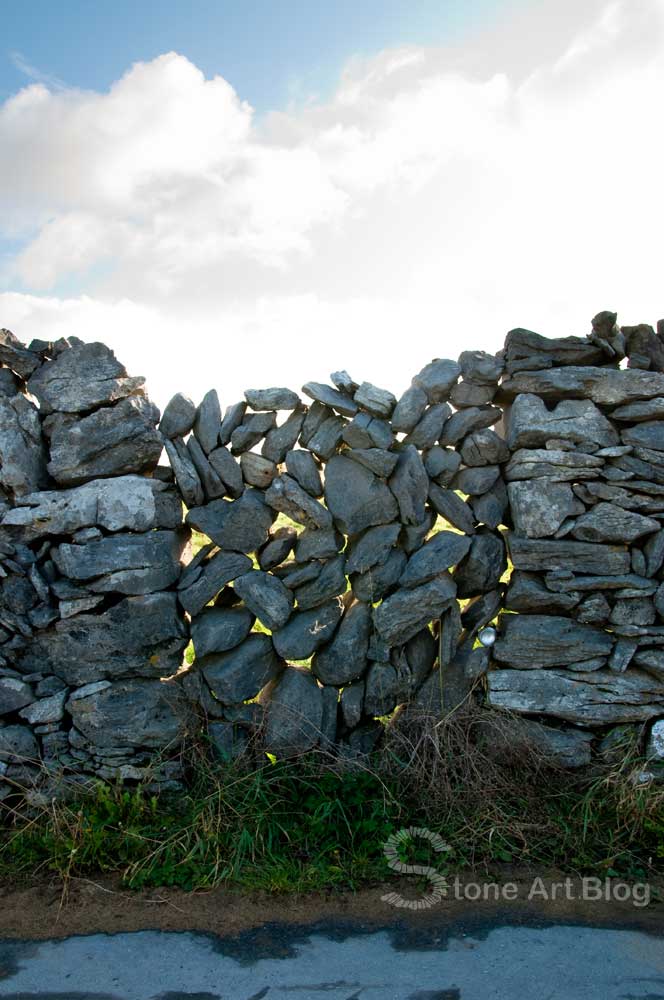
Another walling feature I was very taken by is what is known as an 'Aran gap' or 'Bearna'. There are not a lot of roads around the island so much of the access to the fields is through other fields. However you will quickly notice that there do not seem to be any gates in the walls. This is because gaps are left in the wall where a single lace type wall is stacked in the gap, which can then be easily stacked up and taken down as needed for access for animals.
'Aran gap' or 'Bearna'
Inis Oírr as an island is quite a spectacular place. This year was not only my first time at the workshop, but it was also my first time visiting the island, and I must say I really was taken by the place. The island is an Irish speaking community with a population of about 250 people. And from what I can tell all 250 of them are about the warmest, friendliest people you will ever meet. 
Some of the other friendly locals on the island
The limestone pavement exposed in one of the fields after the soil has been taken by the strong winds.
Inis Oírr island is basically an extension of the Burren landscape . The large limestone pavements that make up the land are made up of crisscrossing cracks known as 'grikes', that leave isolated rocks called 'clints'. The limestone dates from the Visean period, formed as sediments in a tropical sea approximately 350 million years ago, and compressed into horizontal strata with fossil corals, crinoids, sea urchins and ammonites. Glaciation following the Namurian phase facilitated greater denudation. The result is that Inis Oírr is one of the finest examples of a Glacio-Karst landscape in the world.
It is an amazing feat of determination and triumph over hardship, how the locals turned this once unusable limestone pavement landscape into an island of lush green fields. They did this by removing the rough stone to fill the cracks or 'grikes' in the limestone pavement, leaving a flat surface. They also used the rough stone to build the walls that would later protect the fields from the wind. They then drew sand and seaweed up from the beach to create the soil, from which they would then be able to grow crops to feed their families, and grass to graze their animals.

St.Gobnait church 'Cill Ghobnait'
  For such a small island there are also many spectacular buildings and historical sites to visit as well (and I don't just mean the great pubs) You could spend days just wandering around the island looking at them. The island also has a famous shipwreck, better known from the opening credits of the TV series Father Ted
The Plassy wreck, thrown up on Finnish rock in 1960 during a wild storm. No lives were lost as the islanders saved all on board from harm.
There are many more amazing things to discover on the island, but as this is just a blog post and not a book, I will leave it at that. I would recommend everyone, both in Ireland and abroad to take a trip to Inis Oírr. I would also recommend that anyone with an interest in stone do one of the Dry Stone Walling Workshops out there. There are also other great ways of experiencing life on the island, as Inis Oírr also host some great Irish language courses, where you can learn the language by working and living on the island. They also have an arts center with an 'artist in residence' program where artists can take up residence and work on the island for a period of just a few weeks right up to three months.
   
There are lots more photos of the wonderful stone walls and landscape of Inis Oírr in the slide show below.
 
Slide show of the walls and landscape of Inis Oírr  

If you are interested in going to next years workshop, keep an eye out on my facebook page as I will keep you all updated  from there when the dates for next years event are confirmed.

If you are interested in finding out more about the stone walls of Ireland, I would recomend checking out Patrick McAfee's book 'Irish Stone Walls' This is a great little book full of information, useful for both amateur and expert stoneworkers. 

If you are a stone waller or a stonemason in Ireland I recommend checking out and joining the Dry Stone Wall Association of Ireland http://dswaireland.ning.com/

I would also recommend to anyone involved with stone to check out and become a member of the international Stone Foundation http://www.stonefoundation.org/

For more information on the Aran Islands checkout  http://www.aranisland.info/