Showing posts with label Trees. Show all posts

Monday, March 3, 2014

'The tree that ate the church' and other stone hungry Irish trees

Best Blogger Tips
Around this time every year I try and do a special tree themed blog post especially for National Tree Week which this year runs from 2nd March to 8th March.

Reading through this wonderful new book by Aubrey Fennell about the Heritage Trees of Ireland I got inspired to do a blog post on some of the stone hungry trees of Ireland.

This book is full of wonderful photos, stories and information and I thoroughly recommend getting a copy. Below are two stories from the book that I have been permitted by the publishers to share with you. They are the story of The Tree That Ate the Church in Co. Offaly and the story of Castle One Tree in Co. Cavan written in the words of the author.

Heritage Trees of Ireland By Aubrey Fennell. Click here to buy with free worldwide shipping
I have always been fascinated by the folklore surrounding many of Ireland's trees. Many of these trees are also often closely tied to stone I find. Unfortunately though the same trees are also often the slow killers of the same stone structures as was the case below.
The Tree that Ate the Church. Co. Offaly. (Photo from Heritage Trees of Ireland book with the publishers kind permission)

The Tree That Ate the Church, Tihilly Church, Laughaun, Coleraine, County Offaly  
"I have been as guilty as anyone in rushing through the countryside on our improved road network, and not seeing some of the wonders of our beautiful island. The road between Tullamore and Clara was one I had often travelled, when a beam of sunshine illuminated a pair of ash trees I had not noticed before. They are two fields in, behind a farmyard, and after getting permission from the farmer I approached them with growing anticipation.
Surface roots of the first ash seemed ready to grab my ankles and pull me into if gaping cavity. The gargantuan tree did not look benign and, if I did not know better, appeared to be ‘Old Man Willow’ exiled from Tolkien’s Middle-earth. 
It stands on a mound of stones which are the remains of Tihilly church. Moss-covered stones and bark merge to create a trunk 7.6m in girth, a new Irish champion at the turn of the millennium. Since then its
cavity has become a cave, which has shrunk its girth to 7.18m. It supports a respectable storm-damaged crown, and at over 300 years old, is living on borrowed time. It probably started life as an opportunist seedling on the walls of the church, when it was abandoned in medieval times. Two walls remain standing beyond its grasping roots.
The second ash stands proudly clear of all this carnage, and is in the prime of life, ready to guard this religious site when the old brute is gone. It shelters a standing High Cross made from sandstone, which depicts scenes from the Bible, along with geometric and animal interlacing. St Fintan founded a monastery here in the seventh century. The last abbot served here in 936, while the church we see now was built from the stones of previous churches.
Ash trees have a special place in Irish folklore, and massive old trees have been venerated down through the ages. After the hawthorn, it is the tree most likely to be found at holy wells and sites of special significance.
Here we have a tree to rival those of the past and I hope to revisit it before it returns to Middle-earth."

Castle One Tree. Bawnboy, County Cavan
Castle One Tree
(Photo from Heritage Trees of Ireland book with the publishers kind permission)


Castle One Tree
(Photo from Heritage Trees of Ireland book
with the publishers kind permission)
‘Castle One Tree’ is a recently coined name given to an incredible old ash tree which is gorging on what remains of Lissanover Castle between Bawnboy and Templeport. Lissanover translates from Irish as the ‘Fort of Pride’, and the story goes that one of its occupants had a priest murdered at the altar because he had started Mass without him. In medieval times the castle was a stronghold of the ruling McGovern clan, and commanded views of the Barony of Templeport from Fermanagh to the Shannon basin as it fed into Lough Allen. 
Another account translates Lissanover as ‘Fort of Extravagance’; in this version a Baron McGovern was building the castle and had his tenants drive their cows to be milked at the castle every day, and the produce was used instead of water to make the mortar. BuIlocks’ blood was also used, and if anyone refused, the Baron had them hanged.
The McGoverns’ despotic rule did not survive the Elizabethan plantation, and the castle stone was recycled into the construction of Lissanover House in the 18th century. 
By the early 20th century, the mansion had suffered the same fate as the castle, and its stone was reused in the building of local farmers’ homes after the estate was divided up by the Land Commission.
Permission to view the tree from Martin Donohoe on whose land the tree stands is essential, as the grazing bullocks may have an ancestral memory of what happened to their forebears. Climb the hill until it levels off, and only bumps and hollows remain of the fort, except for the stout ash on its pedestal of stone. The trunk is over 7m in girth although it is not a conventional trunk, as many roots drop down from the original height of the wall where the ash seeded itself some 300 years ago. The tree’s height and spread is over 18m, and it is obviously thriving on its diet of blood and milk. It is clear why this tree was left well alone, for who knows what malevolent spirit might be released if it is interfered with? The McGoverns had the habit of imprisoning their opponents in wooden barrels with nails driven in and rolling them down the hill from this castle.

Below are two other trees that are stone bound which I have long admired. The first is an old crab apple growing out of a sold rock (an old mass rock I believe) close to my family home in West Cork.

Crab Apple tree, Mealagh Valley, West Cork. (Rock not very visible from this angle as grass has creped up over the rock on this side.) 
 The tree below is a lovely old Hawthorn growing through the wall at the 12th century St Doulagh's Well, in the outskirts of Dublin city. I love how the wall around the Hawthorn tree has carefully been maintained and repaired over the years to allow the tree to grow freely through the wall. It was actually visiting this site that  inspired me to incorporate the Hawthorn 'fairy tree' into the outdoor classroom project I created for the school in Donabate.

Hawthorn growing through the wall at the 12th century St Doulagh's Well

Planting the fairy tree in the outdoor classroom
The Fairy Tree in place

In regards to other Stone Hungry Trees, I also like this photo by Ken Curran of vines consuming a dry stone wall in Co. Tipparary

Vines consuming a dry stone wall in Co. Tipperary (Photo by Ken Curran of Earthstone)

Grave Yards are also great places to see stone eating trees.
Stone Hungry trees in Glasnevin cemetery in Dublin

If you want to see some funny hungry trees from around the world, you should check out this link http://hungrytrees.com/


You can see my previous posts for National Tree Week here.


There are plenty of events on around the country this week for National Tree Week. To find out what is happening in your area or to advertise your own event, check out the Tree Council of Ireland website http://www.treecouncil.ie/initiatives/treeweek2014.html

Thanks again to Collins Press  for allowing me to share the stories from their book. The Book Depository has the wonderful  Heritage Trees of Ireland book on sale at the moment with 39% off plus free worldwide shipping so click here to get yourself a copy 

Tuesday, February 5, 2013

The Family Tree Mosaic

Best Blogger Tips

As part of the sculptural outdoor classroom that I am working on at the moment for a school here in Dublin, I was asked to incorporate a tree somewhere into the design to represent the 'Family Tree'. The 'Family Tree' is a song which has come to symbolise the 'Croí na Scoile' (The heart of the school).
I was also asked to give the students a chance to have some input into the outdoor classroom so that they can make it their own (a very important part of the process for sure) 


My solution to this was to create a large stone mosaic of the tree into the wall of the structure and to then let the students paint the leaves of the tree on precut tiles.
Past pupils, staff, board and PTA members (past and present) received a leaf to design and paint.
Almost 100 leaf tiles were painted as well as another 70 square tiles that make up the border around the mosaic.
It was great to spend some time in the classroom with students and see the excitement about creating their very own piece of art that will remain part of the outdoor classroom for years to come.

Painting the leaf tiles in class

The finished leaf tiles painted by the students


Many many hours went into the making of the stone part of the mosaic, far more than anyone will ever know, but now that it is finished I know that it was all worth it. 
The roots of the tree

The border tiles that surround the mosaic spell out 'All different all equal' as well as its Irish translation 'Gach duine atá difriúil ach freisin cothrom'  
There is still lots to do before the outdoor classroom is complete with lots more exciting features and student involvement also, so I will get back to work now, and will post more about the outdoor classroom once it is completed.

Wednesday, March 7, 2012

Tree Art for National Tree Week

Best Blogger Tips
Like every year on National Tree Week I like to do a tree related post. And as it is National Tree Week here in Ireland at the moment, I thought I would mention some 'tree themed' sculptures that I really like.

Ute Lennartz-Lembeck's Weeping Willow tree sweater in Velbert, Germany

German artist and art teacher  Ute Lennartz-Lembeck took up the hobby, also known as "yarnbombing", after seeing the work of others on a visit to Berlin.

Graffiti knitters typically install their stitched creations on signposts, statues, bicycles and any other surface that can serve as a creative display space. And just like graffiti of a more permanent kind, their work can be politically motivated, whimsical, witty or inane. Though they commonly call themselves graffiti or guerilla knitters, some of their works like the Weeping Willow tree sweater is actually crochet.
The tree sweater in Velbert, required 200 hours and 400,000 stitches to complete.

Being Ute's first project, she decided to work with a tree as it is a symbol of life, its roots, stem and crown are interdependent, one can not live and grow without the other... 
Unlike some knitting guerrillas who follow the lead of traditional graffiti artists like Banksy and keep their identities secret, Lennartz-Lembeck has taken on the role of yarnbombing ambassador, installing her creations openly and during the daytime, which often spurs conversation with curious strangers.


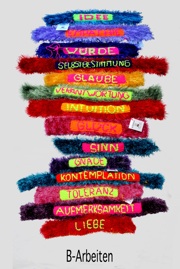
Ute also has a global project called B-Arbeiten or B-Work.
B-work is a worldwide network of single-word banners, attached to trees, lampposts, letterboxes, in fact anywhere that might catch the glance of passers-by in a bid to get them to reconsider their surroundings.
Ute explains that this is not the work of a single person, but of many people; friends, acquaintances and people who show interest in putting the works into their environment. Ute sends the various banners free of charge to willing accomplices all over the world. There are now over 200 attached 'values', in many places in the world. The work comes back to her in the form of a photo that she in turn, shares with the world the world on the B-Arbeiten facebook page or on her homepage.
Find out more about Ute's fantastic work on her website here.

Above photos courtesy of Ute Lennartz-Lembeck.

Another sculpture I love is this Tree Troll by artist Kim Graham.
The Tree Troll. A huge 12-foot tall troll is built by Kim and volunteers with completely non-toxic materials.
Kim Graham began her art career as a painter in acrylics in the late 1980's but quickly moved to sculpture. She has been sculpting since then in a wide variety of media and sizes ranging from 22' wide fiberglass dragons to fired clay figuratives to architectural ceramic pieces. Kim has in recent years moved away from her special effects/fantasy based mold-making work to focus intensely on one-of-a-kind fine art sculptures. These range from beautiful Art Nouveau inspired figurative plaques to busts and portraits.
The sculpture concept
Kim's inspration for this sculpture has a lot to do with her Norwegian descent, and when the 'Lord of the Rings' movies came out, she recognized the Ents as being similar to tree trolls from Scandinavian Mythology. People identify with this image, but it has special meaning to Kim as she grew up in a small logging community in Montana, and most of her life was spent hiking and camping in the deep forests of the Northwest. The great cedar trees have always instilled a sense of awe in her, and  a surprising sense of awareness. They seemed thoughtful creatures, old, wise, and kind. Seeing the character of Treebeard in the movies inspired her to do a Northwest version.

A troll in the making. Some of the 25 volunteers that helped create the sculpture. 
This 12 foot tall sculpture was surprisingly made from paper mache. She chose this unconventional method for a number of reasons. Most sculptors never get the chance to work large scale. It can be really expensive. A lot the materials are toxic, require safety equipment, a lot of ventilation or at the very least an outdoor site. That is the joy of working in paper mache. This troll was built in a space barely larger than the sculpture itself. It was done indoors with no additional ventilation and with a lot of recycled paper products. Best of all, this project was intended to prove just how beautiful and sophisticated a surface can be made.

Since its creation in 2006, the tree troll has been touring many garden shows and local markets. One of the downsides to the troll being made from paper mache is that it cannot be left outdoors. This year Kim is planning a new version that will be made in concrete, which will be permanently located outdoors.
Concept picture for the new concrete tree troll
Tree troll photos courtesy of Kim Graham. Check out her website to see more of her lovely work. 

Below are a few pictures of some other tree related sculptures I really like.
Heart Of Trees by Spanish artist  Jaume Plensa. Photo courtesy of littlestschnauzer
Claude Lalanne - "La Pomme de Guillaume Tell" (William Tell's Apple)
Photo courtesy of David Pittuck
Hanging trees by Andy Goldsworthy. Photo courtesy of  Dave AKA RoystonVasey
"Sycamore" by Wendy Taylor. Photo courtesy of malcolm bull
Joseph Wheelwright’s Tree Figures. Photo courtesy of Elena AKA elalex2009
This sculpture, I cannot find any information about. If you are the owner of the photo or the creator of this wonderful work, or indeed know who it belongs to,  please email me.
-------------------------------------------------------------------------------------------------
Photos from previous years National Tree Week blog posts
You can see my previous posts for National Tree Week here.
Also check out my post on two of Ireland's wonderful native trees, Blackthorn, Shillelaghs and the tree of the fairies, the Hawthorn

There are plenty of events on around the country this week for National Tree Week. To find out what is happening in your area or to advertise your own event, check out the Tree Council of Ireland website http://www.treecouncil.ie/treeweek/treeweek.html

Friday, March 11, 2011

This year for National Tree Week, why not let the trees do some art!!!

Best Blogger Tips
So it's National Tree Week again here in Ireland! Last year in my post Grow our own chairs for national tree week, I instructed ye all to go and create some art by growing a chair out of trees. (I have yet to hear from ye how that went). So this year, why not let the trees themselves make some art!
Picture from last years post 'Grow our own chairs for national tree week'

This is precisely what British artist Tim Knowles did back in 2005 when he started his series of art pieces, simply called ‘Tree Drawings’ Tim’s idea was to create a series of drawings produced using drawing implements attached to the tips of tree branches, the wind’s effects on the tree is then recorded on paper.  Like signatures, each drawing reveals the different qualities and characteristics of each tree.

All of his works rely on the logic of cause and effect, as a map of time and a record of actions governed entirely by chance.
 
Tree Drawing - Weeping Willow on circular panel [100 pen] 2005
Above, 100 pens attached to the branches of a Weeping Willow tree draw onto a circular disc 5.1 metres in diameter and made up of 10 segments.
Larch on Easel #1 2006

Scots Pine on Easel #1 2006


Similar projects by Knowles include his Vehicle Motion Drawings, where he constructed an apparatus to capture the motion of a car being driven, all the turns, stops, and starts of the vehicle move the pen over the paper. Another is  his postal projects, which capture the motion of packages sent through the postal system, using both drawings and photography.
Greek Pine on easel #1 2005

I think my favorite work of his is titled ‘Nightwalk - Valley of Rocks’.  
Nightwalks are a series of illuminated walks that Knowles created in the countryside during a new moon (to ensure complete darkness).
One of Tim Knowles contraptions
Over the period of an hour, the artist walked away from the camera while carrying three wide-beam torches fitted with diffusers. The lights are connected to a 12volt battery in a backpack to prolong their life. His path, along a precarious rocky ridge in the darkness, was illuminated and captured using a long-exposure, large-format photograph. The direction in many of his walks are also dictated by the wind by using various contraptions that plot the direction of the wind.
Nightwalk - Valley of Rocks 2008
Photos and info from Tim Knowles website. Be sure to check it out to see more of his amazing work
http://www.timknowles.co.uk

So it's still National Tree Week for a few days and there are still a number of events on this weekend right around the country. To find out what in happening in your area, follow the tree council of Ireland link http://treecouncil.ie/

2011 also happens to be the International Year Of The Forest. You can find out more about this here http://www.un.org/en/events/iyof2011/

Tuesday, May 4, 2010

Blackthorn, Shillelaghs and the tree of the fairies, the Hawthorn

Best Blogger Tips

Blackthorn (Prunus spinosa) Draigean (Gaelic name)

Anyone driving on any country roads in Ireland at the moment will have noticed the beautiful white flowers of the Blackthorn, which has exploded onto the stage over the past few weeks.

This native Irish tree may be known by its Latin name Prunus spinosa or one of its many common names, such as sloe, wild plum, wishing thorn or mother of the wood. A close relative of cherries and plums, Blackthorn is a deciduous small tree or large shrub, growing up to 4 metres high at a medium growth rate. It is often found growing wild in hedgerows, on the edges of wooded areas or popping up on rough farmland.
The Blackthorn gets its name from its black bark, this bark is sometimes used to make an ink.

The five petalled, snow white flowers of the Blackthorn are at their best from March through April. The blooms appear before the leaves unfold (this is one of the easiest ways to tell the difference between Blackthorn and Hawthorn)
It's flowers before leaves for Blackthorn and leaves before flowers for Hawthorn.


The early Blackthorn flowers are followed by the finely serrated, dull-green oval leaves, which in turn are followed by blackish purple sloes in autumn. Sloes, the fruit of the Blackthorn, are extremely sour and are sometimes used for flavouring sloe gin.

The thicket like growth combined with Blackthorns notoriously vicious woody thorns, and the ability to re-grow quickly after cutting makes for an ideal stock proof new hedging material or as a replacement plant for existing hedgerow gaps.
Blackthorn is very valuable to birds as a nesting site. Blackbird, song thrush, finches, common whitethroat and wood pigeon are among the more common users.

The wood of the Blackthorn is both hard and light weight, this makes it is ideally suited to the manufacture of clubs/walking sticks. These sticks are known as ‘Shillelaghs’ and are better known as part of the Irish cliché ‘shamrocks and shillelaghs’

Hawthorn (Crataegus monogyna) Sceach Gheal


Just as the flowers of the Blackthorn begins to fade the Hawthorn explodes into flower, matching the floral show of the Blackthorn in colour and intensity.

The Hawthorn, or by its Latin name Crataegus monogyna, also known as Quickthorn, Whitethorn, or the May tree, is one of the most common small trees/large shrubs grown in Ireland. It is sometimes grown as individual trees, but it is more common to see it grown in a closely planted row as a hedge or screen. It is the ideal candidate for this, as young hawthorn plants grow strongly with many thorny branches and side-shoots. This quickly forms a thicket, which makes for a virtually stock-proof hedge.


A bushy tree, Hawthorn grows on average, to a height and spread of 6 metres.
Unlike Blackthorn whose stems are dark, the stems of Hawthorn are light grey turning to a pinkish brown colour with age, which is also when characteristic filled cracks start to appear up along the trunk. Most of the young twigs sprouting from the tree emerge red before going through these colour changes.
The glossy green leaves are between 20 to 30mm long and are divided into 3, 5 or 7 deeply cut lobes. The tree comes into leaf at the end March.

It is in flower from May to June with 5-petalled white flowers, which unfortunately have an unpleasant smell to some. You see, up close the flowers have a faint scent of rotting meat. This allows pollination of the flowers by flies rather than bees which are not active in early spring, its blooming time.

By September lots of red berries appear, these berries are known as ‘haws’. Birds will feed on these through the winter and so can we, although they don’t really taste of very much. They are dominated by a stone, which must not be cracked when eating the flesh of the berry, but they can be roasted and ground into a coffee substitute. The stone is often made up of several segments which tend to fuse together to appear as one. The berries are mostly used to make jams, and fruit leathers.


Our native tree of the fairies


In Irish myths and legends, there are many references to Hawthorn or Whitethorn and its connection with the fairy folk. It was once believed that to place a sprig of fairy Hawthorn in your milking parlour would cause your cows to supply extra pints of creamier milk.

It is also said that fairies who gather around a thorn tree are thought to be earth spirits and as a precaution no evil thing is ever said of them for fear of retribution. The old belief that any damage done to their trysting tree will bring misfortune to the doer has not died out and farmers still laboriously cultivate around them. In several instances it has been impossible to persuade workmen to remove a thorn tree from the route of a new road or footpath (as the picture below of a Hawthorn from somewhere in rural Ireland clearly shows), and there is widespread belief that to cut a thorn would bring ill luck on the person 'injuring' the tree and possibly death.*


Another use of the Hawthorn in Irish myths and legends is a Hawthorn known as St Ciaran's Bush. Ciaran was a fifth century saint who founded a monastery here.

Located at Clareen, east of Birr in the midlands of the country, the lonely Whitethorn is dressed in clothing rags (giving it its more impertinent name, the rag bush). It is believed that the bush cures illness and answers prayers, so when a piece of the persons clothing is placed on the bush, once the rag has rotted to nothing, their prayers and intentions will be answered. (It is also believed by some that the increase in the bush's use over the last few years is a reflection of the state of medical services in Ireland)

The tree does not appear to be particularly old, but it has been confirmed that the same bush has been decorated for at least 40 years. It is likely that the present tree replaced an older one.
The local people helped to preserve the tree when it was in danger of being felled due to the realignment of the road some years ago. It now stands on an island of grass, surrounded by low white railings, the old road on the west side, and the new road on the east.*

An old Hawthorn tree left grow through the wall at St Doulagh's holy Well,  in the outskirts of Dublin city.  I love how the wall around the Hawthorn tree as carefully been maintained and repaired over the years to allow the tree to grow freely through the wall.  

* References  [Tree Heritage or Britain and Ireland by Andrew Morton]